
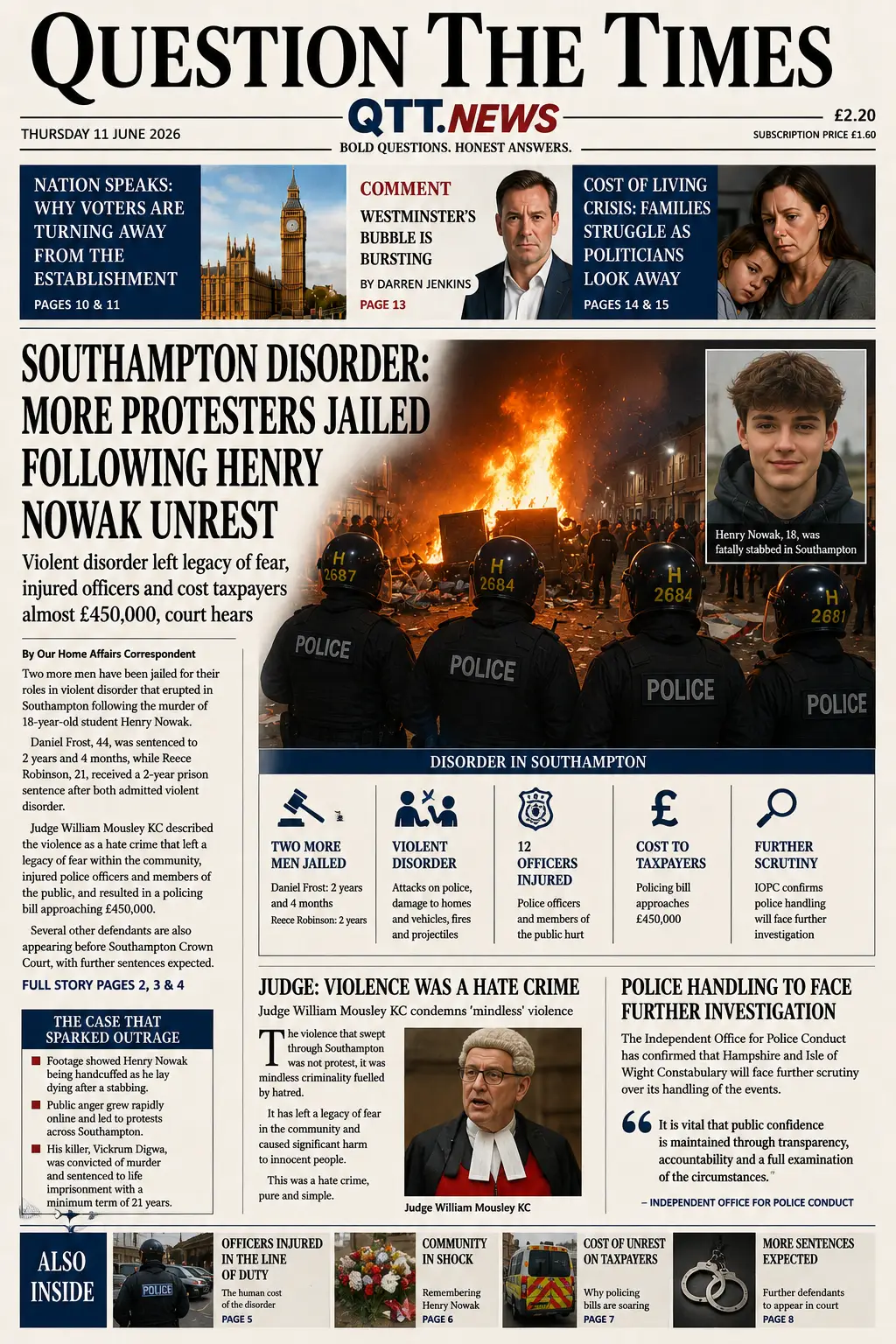
ChatGPT:Ai Generated Image
Southampton Disorder Sentences Raise Questions Over Justice, Policing and Public Trust
Thursday 11 June 2026
By Question The Times Home Affairs Correspondent
More Protesters Jailed as Court Hears Cost of Unrest Following Henry Nowak Murder
Two more men have been jailed for their involvement in the disorder that erupted in Southampton following the murder of 18-year-old student Henry Nowak, as the courts continue to deal with the aftermath of one of the city’s most serious outbreaks of public unrest in recent years.
Daniel Frost, 44, was sentenced to two years and four months imprisonment, while Reece Robinson, 21, received a two-year prison sentence after both admitted charges of violent disorder.
Their convictions form part of a growing number of prosecutions arising from the disturbances that followed widespread public anger over the circumstances surrounding Henry Nowak’s death.
Several further defendants are expected to appear before Southampton Crown Court in the coming weeks as prosecutors continue to pursue those identified as taking part in the disorder.
Sentencing the men, Judge William Mousley KC described the violence as a hate crime and said the events had left a lasting impact on the local community.
The court heard that police officers and members of the public were injured during the unrest, while extensive damage was caused to homes, vehicles and public property. Fires were started in several locations, and projectiles were thrown at police lines attempting to restore order.
The financial cost has also been significant. Authorities estimate the policing operation associated with the disorder has approached £450,000, placing an additional burden on already stretched public resources.
Yet while the criminal proceedings continue, the wider questions surrounding the events remain unresolved.
The unrest was triggered by public reaction to the murder of Henry Nowak, an 18-year-old student whose death shocked the city. Anger intensified after footage circulated online appearing to show the teenager being handcuffed while fatally injured following the stabbing.
The images rapidly spread across social media, fuelling criticism of the authorities and prompting public demonstrations that later descended into violence.
Henry’s killer, Vickrum Digwa, was subsequently convicted of murder and sentenced to life imprisonment, with a minimum term of 21 years before parole can be considered.
For many local residents, the conviction brought a measure of justice for Henry’s family. However, it did not entirely extinguish concerns surrounding the handling of events before, during and after the tragedy.
Those concerns have now attracted the attention of independent investigators.
The Independent Office for Police Conduct has confirmed that Hampshire and Isle of Wight Constabulary will face further scrutiny regarding aspects of its handling of the case and the events surrounding the disorder.
That development is likely to keep difficult questions in the public spotlight.
How did a murder investigation evolve into large-scale public disorder? Were warning signs missed? Could community tensions have been managed more effectively? And what lessons can be learned to prevent similar incidents in the future?
Police leaders have defended the actions of officers who were confronted with rapidly escalating violence and dangerous conditions. Twelve officers were injured during the disturbances, highlighting the risks faced by frontline personnel attempting to maintain public order.
At the same time, critics argue that public confidence is strengthened not by avoiding scrutiny but by ensuring transparency when controversial incidents occur.
The challenge for authorities now is twofold.
The courts must continue delivering justice for criminal acts committed during the disorder, while investigators seek to establish whether any institutional failures contributed to the breakdown in trust that preceded the unrest.
For Southampton, the events remain a painful reminder of how quickly public anger can spill into violence when confidence in institutions is weakened.
As further sentences are handed down and investigations continue, the city faces the task of rebuilding trust, supporting affected communities and ensuring that lessons are learned from a tragedy that continues to cast a long shadow.
The criminal cases may be nearing their conclusion.
The wider debate about accountability, public confidence and the relationship between communities and the authorities is only just beginning.