
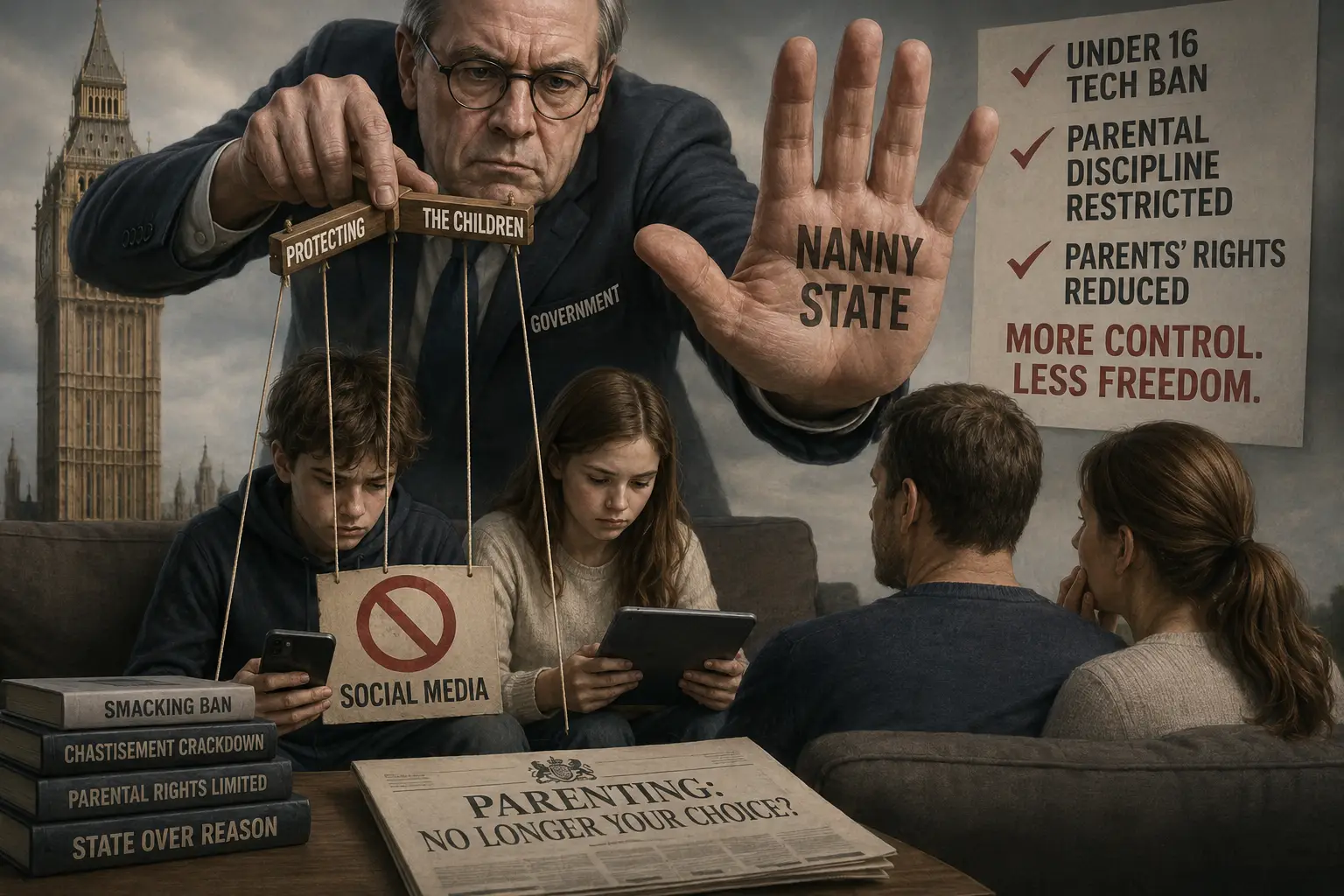
The Expanding Nanny State: Why Parenting Should Not Become a Government Function
For generations, British governments of all political colours have spoken of the virtues of personal responsibility. Families, we were told, form the bedrock of society. Parents were expected to guide, discipline and protect their children. Yet with each passing year, Westminster appears increasingly determined to transfer those responsibilities from the home to the state.
The latest proposal to restrict or ban under-16s from using social media and certain technology platforms represents another step along this well-trodden path. While concerns over online safety are genuine and deserve serious attention, the fundamental question remains: should government assume responsibilities that rightly belong to parents?
Supporters of stricter regulation argue that social media companies have become too powerful and that children are vulnerable to harmful content. Few would dispute either point. However, it is a significant leap from recognising a problem to concluding that the state should become the primary guardian of every child in Britain.
Parents have always faced challenges in raising children. Previous generations worried about television, video games, violent films and unsuitable magazines. The role of a parent was to set boundaries, establish rules and determine what was appropriate for their own children. Not every household reached the same conclusions, but that diversity reflected a free society in which families retained the authority to make decisions according to their own values.
The proposed restrictions risk undermining that principle. If the government decides that parents cannot be trusted to regulate their children's use of social media, what responsibility will be removed from them next?
This question is not merely theoretical. Over recent decades, the state has steadily expanded its influence into areas once considered private matters. Debates surrounding parental discipline provide a notable example. Measures limiting or redefining the ability of parents to physically chastise children have been justified on safeguarding grounds. Whatever one's position on smacking, the direction of travel is unmistakable: decisions once left to families increasingly fall within the remit of lawmakers, regulators and social services.
Each individual intervention may appear reasonable in isolation. Yet the cumulative effect is significant. The state assumes a greater role, while parental authority is correspondingly diminished.
Britain's political class often speaks of rights. Less frequently discussed is the relationship between rights and responsibilities. A society in which citizens surrender responsibility to government inevitably finds itself surrendering freedom as well. When the state becomes responsible for solving every social problem, it must also acquire the powers necessary to enforce its solutions.
This is the paradox at the heart of modern politics. Governments promise protection from every conceivable risk, yet protection invariably comes at the cost of autonomy. The more officials seek to shield citizens from harm, the more they regulate behaviour, monitor activity and restrict choice.
The debate over children's access to technology should therefore extend beyond questions of online safety. It concerns the broader relationship between citizen and state. Are parents still regarded as the primary decision-makers in their children's lives, or are they becoming junior partners in a system increasingly directed from Whitehall?
No sensible person would deny that social media presents risks. Nor should technology companies escape scrutiny for practices that may harm young people. But there is a profound difference between holding corporations accountable and relieving parents of their responsibilities.
A healthy society depends upon capable, engaged parents. It cannot function indefinitely if every difficult decision is outsourced to government. Indeed, the more the state assumes responsibility for raising children, the less incentive remains for parents to exercise their own judgement and authority.
The danger is not that Britain suddenly becomes an authoritarian state. The danger is subtler than that. Freedom is rarely lost in dramatic fashion. More often, it is eroded gradually through a series of well-intentioned measures, each introduced in response to a genuine concern.
One regulation becomes two. One restriction becomes three. A parental responsibility becomes a government programme. A family decision becomes a legal requirement.
And by the time citizens notice how much authority has shifted from the home to the state, the transfer has already taken place.
The question facing Britain is therefore larger than social media. It is whether we still believe that parents should raise children, or whether we increasingly expect government to do it for them.
The answer will shape not only the next generation's relationship with technology, but also our nation's understanding of liberty itself.