

ENVIRONMENT
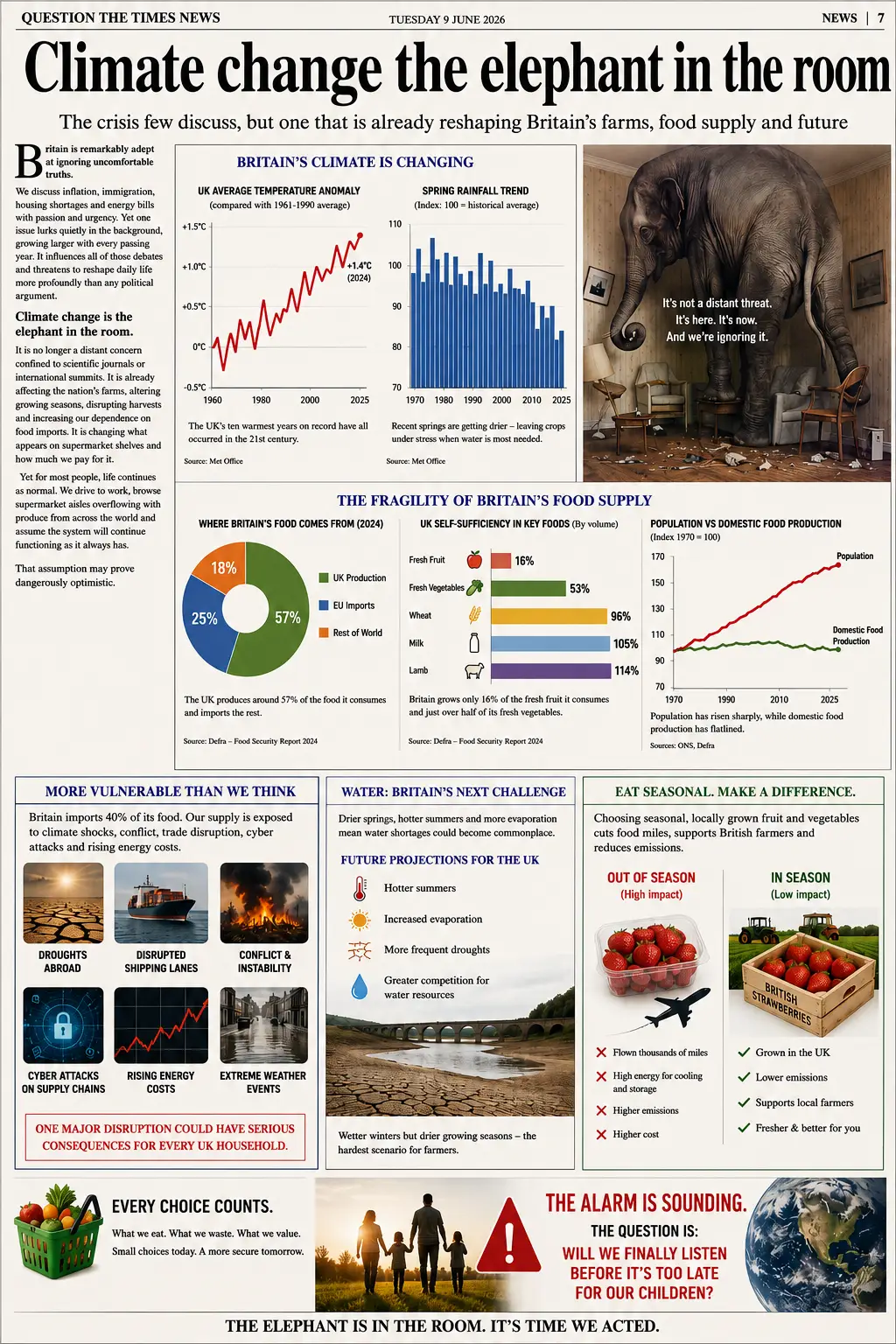
ChatGPT: Ai generated image
Tuesday 9 June 2026
Environment Corespondent: SJ
CLIMATE CHANGE: The Elephant in the Room
The crisis few discuss, but one that is already reshaping Britain's farms, food supply and future
Britain is remarkably adept at ignoring uncomfortable truths.
We discuss inflation, immigration, housing shortages and energy bills with passion and urgency. Yet one issue lurks quietly in the background, growing larger with every passing year. It influences all of those debates and threatens to reshape daily life more profoundly than any political argument.
Climate change is the elephant in the room.
It is no longer a distant concern confined to scientific journals or international summits. It is already affecting the nation's farms, altering growing seasons, disrupting harvests and increasing our dependence on food imports. It is changing what appears on supermarket shelves and how much we pay for it.
Yet for most people, life continues as normal. We drive to work, browse supermarket aisles overflowing with produce from across the world and assume the system will continue functioning as it always has.
That assumption may prove dangerously optimistic.
Britain's Climate Is Changing
The evidence is now difficult to dismiss.
The UK's ten warmest years on record have all occurred in the 21st century, according to the Met Office. Recent springs have repeatedly broken temperature records, while farmers increasingly report drought conditions during critical growing periods. (The Times)
UK Average Temperature Change
Average UK Temperature Anomaly
(compared with 1961-1990 average)

+1.5°C |                           █
+1.3°C |                         █ █
+1.1°C |                       █ █ █
+0.9°C |                   █ █ █ █ █
+0.7°C |               █ █ █ █ █ █ █
+0.5°C |           █ █ █ █ █ █ █ █ █
+0.3°C |       █ █ █ █ █ █ █ █ █ █ █
+0.1°C | █ █ █ █ █ █ █ █ █ █ █ █ █ █
                  1960   1980   2000   2025
The trend is unmistakable. Britain is warmer than it was a generation ago, and scientists expect temperatures to continue rising throughout this century. (Met Office)
Rainfall: Too Much, Too Little, At The Wrong Time
One of the great misconceptions about climate change is that it simply means warmer weather.
For farmers, the real problem is instability.
Britain is experiencing increasingly erratic weather patterns. Some regions face prolonged droughts during spring and summer, while winter months bring intense rainfall and flooding. Both extremes damage agricultural productivity. (GOV.UK)
Spring Rainfall Trend
Average UK Spring Rainfall
(Index: 100 = historical average)

110 | ███████████
105 | ██████████
100 | █████████
 95 | ████████
 90 | ███████
 85 | ██████
      1970 1980 1990 2000 2010 2025
Recent record-breaking springs have been among the driest on record, leaving crops under stress precisely when water is most needed. Farmers across England have reported lower soil moisture levels and increasing concerns about irrigation supplies. (The Guardian)
The consequence is not merely a poor harvest. It is reduced food security.
The Fragility of Britain's Food Supply
Many Britons assume that food security is a problem for developing nations.
The reality is more complicated.
The United Kingdom currently produces approximately 57–62 per cent of the food it consumes and relies on imports for roughly 40 per cent. The European Union remains the largest source of imported food. (GOV.UK)
Where Britain's Food Comes From
UK Food Consumption Sources (2024)

UK Production    ███████████ 57%
EU Imports         ████████      25%
Rest of World      ████         18%
(GOV.UK)
At first glance, that may seem reassuring.
But the picture becomes more troubling when examining fresh produce.
UK Self-Sufficiency in Key Foods
Food Type                UK Production

Fresh Fruit           ██ 16%
Fresh Vegetables  ████ 53%
Wheat                   ███████ 96%
Milk                      █████████ 105%
Lamb                     ██████████ 114%
(GOV.UK)
Britain grows only around 16 per cent of the fresh fruit it consumes and just over half of its fresh vegetables. (GOV.UK)
When drought strikes southern Europe, flooding affects Spain, conflict disrupts trade routes, or energy prices surge, British consumers feel the consequences almost immediately.
Climate change therefore presents a double threat:
It damages domestic production.
It destabilises the overseas suppliers on which Britain increasingly relies.
Population Growth Versus Food Production
Britain's population has risen substantially over recent decades, while agricultural land remains finite.
Population vs Domestic Food Production
Index (1970 = 100)

170 |        Population
160 |               █
150 |             █ █
140 |           █ █ █
130 |         █ █ █ █
120 |       █ █ █ █ █
110 |     █ █ █ █ █ █
100 |   █ █ █ █ █ █ █
      1970    1990    2010   2025
While agricultural productivity has improved through technology, climate volatility is beginning to erode those gains. The margin for error is shrinking.
A nation that imports two-fifths of its food is heavily dependent upon stable weather, reliable shipping, functioning ports and peaceful international relations.
Increasingly, none of those can be taken for granted. (GOV.UK)
Water: Britain's Next Great Challenge
The notion of water shortages in Britain sounds absurd.
We are, after all, a famously wet country.
Yet experts increasingly warn that droughts and water stress could become common features of British life as rainfall patterns shift and summers become hotter. Record dry springs are already affecting reservoirs and agricultural irrigation. (The Guardian)
Future climate projections suggest:
Hotter summers.
Increased evaporation.
More frequent droughts.
Greater competition between households, industry and agriculture for water resources. (Met Office)
The likely result is a paradoxical Britain: wetter winters but drier growing seasons.
For farmers, that is among the most challenging scenarios imaginable.
The Geopolitical Risk We Rarely Discuss
Food security is no longer merely an agricultural issue.
It is a national security issue.
Recent analyses have warned that Britain's highly integrated food supply chains are vulnerable to climate shocks, cyber-attacks, energy disruptions and geopolitical instability. Experts have described the system as increasingly exposed to a single major disruption. (The Guardian)
A drought in Spain.
A conflict affecting shipping lanes.
A cyber-attack on logistics networks.
A prolonged heatwave across Europe.
Any one of these events can affect prices. Several occurring simultaneously could have far more serious consequences.
The Simplest Climate Action Is On Our Plates
While governments debate net-zero targets and international agreements, one of the most practical actions available to consumers is surprisingly simple:
Eat seasonally.
Choosing British-grown fruit and vegetables when they are naturally in season reduces the energy required for transportation, refrigeration and long-term storage.
Strawberries in June rather than January.
Apples in autumn rather than imported alternatives flown from thousands of miles away.
Root vegetables in winter rather than produce transported across continents.
These choices support local farmers, strengthen domestic food production and reduce emissions associated with long-distance supply chains.
Millions of small decisions can collectively create substantial change.
The Alarm Bell Few Are Hearing
Perhaps the most unsettling aspect of climate change is not what it may do in fifty years.
It is what it is already doing now.
Fields are drying earlier.
Growing seasons are changing.
Weather patterns are becoming less predictable.
Food imports are becoming increasingly vulnerable to events beyond Britain's control.
And yet much of society carries on as if none of this matters.
Climate change remains the elephant in the room: impossible to ignore once acknowledged, yet strangely absent from everyday conversation.
Future generations may one day ask why the warning signs were so visible, why the evidence was so abundant, and why action was so slow.
The answer may be uncomfortably simple.
The alarm was sounding all around us.
We had simply grown accustomed to ignoring it.

New Resilient Nature report reveals habitats stretched to breaking point by climate extremes and human pressures.
Byline
By Eleanor Grey, Environment Correspondent
Main Article — Page 1
LONDON, 27 September 2025 — A stark new report published today by The Wildlife Trusts lays bare the perilous condition of the United Kingdom’s wild species and habitats under accelerating climate stress. Resilient Nature, the Trusts’ adaptation assessment for 2024/25, draws on data from their 2,600 nature reserves and warns of a “nature breaking point” as extreme weather becomes ever more unpredictable. The Wildlife Trusts+1
The report identifies drought, heatwaves, wildfires, and volatile rainfall as the greatest pressures faced by ecosystems. Over the past 12 months, peat bogs, heathlands and wetlands have desiccated; ponds and streams failed to sustain amphibians and dragonflies; and reserve managers documented charred nests at sites such as Upton Heath in Dorset. The Wildlife Trusts+1
“We are now witnessing climate extremes not as distant threats but as daily realities for wildlife,” says Dr. Sinead Walker, lead author of Resilient Nature. “Ecosystems once able to absorb shock are losing resilience.”
Even in less acute circumstances, the report highlights chronic declines: species abundance on studied taxa has fallen by an average 19 % since 1970, and almost one in six species assessed in Great Britain faces risk of extinction. National Trust+1
The Trusts caution that government mitigation and adaptation efforts remain dangerously underfunded. Without urgent intervention on land management, emissions, habitat connectivity and legal protection, the report warns, losses may become irreversible.


By Question The Times Environment Correspondent
The British public is being asked to lend a hand in one of the most unusual – and important – conservation efforts of the summer: tracking wasps. Far from being mere picnic pests, wasps play a crucial role in pollination and natural pest control, and scientists are now eager to understand more about their habits, distribution and population health across the UK.
The government’s Centre for Ecology & Hydrology (CEH), alongside university research teams, has launched a nationwide survey, encouraging people to log sightings of wasps through dedicated apps and websites. Volunteers are asked to submit photographs, nest locations and behavioural observations. The data will help ecologists build a detailed map of how wasp species are responding to climate change, urbanisation and agricultural practices.

ChatGPT:Ai generated image